



Diamond Saw Blade Manufacturing: A Comparison of Common Processes
When choosing a diamond saw blade, many users focus mainly on diamond concentration, blade size, or price. However, the manufacturing process also plays an important role in determining cutting performance, durability, and application suitability.
Although different diamond blades may look similar from the outside, the way the diamond segments are produced and attached to the steel core can significantly affect their working life and cutting stability.
This article introduces four common manufacturing processes used for diamond saw blades: cold pressing, hot pressing, brazing, and laser welding, and explains their typical characteristics and applications.
1. Cold Pressing
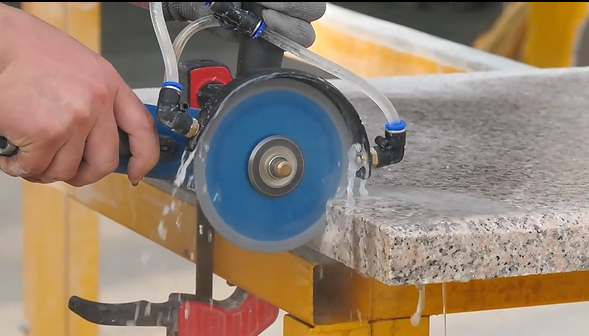
Cold pressing is a basic method used to form diamond segments. A mixture of diamond grit and metal powders is pressed into a mold at room temperature to achieve the required shape. The formed segments are then sintered in a furnace, allowing the metal powders to bond and hold the diamond particles together.
Characteristics:
▪Simple production process
▪Lower equipment investment
▪Suitable for cost-sensitive applications
▪Provides basic diamond retention performance
Typical applications:
Cold-pressed diamond blades are commonly used for light-duty cutting tasks, occasional projects, and softer materials such as bricks, blocks, and aerated concrete.
2. Hot Pressing
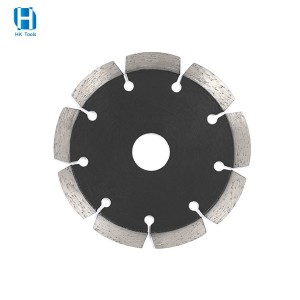
Hot pressing combines pressure and heat during the segment forming process. The diamond-metal powder mixture is pressed inside a heated mold, creating a denser and more uniform metal matrix.
Characteristics:
▪Higher segment density
▪Better diamond particle retention
▪More stable cutting performance
▪Longer service life compared with basic cold-pressed segments
Typical applications:
Hot-pressed diamond blades are often used for professional cutting applications, including granite, reinforced concrete, asphalt, and other hard materials requiring continuous operation.
3. Brazing
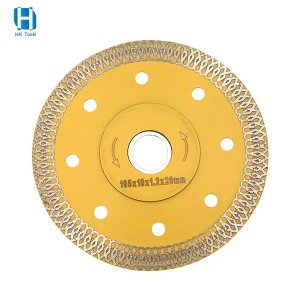
Brazing is a process where diamond segments are manufactured separately and then attached to the steel core using a brazing alloy. During heating, the filler material melts and bonds the segment to the core.
Characteristics:
▪Mature and reliable joining technology
▪Suitable for many standard cutting applications
▪Allows flexible segment designs
▪Generally lower cost than laser welding
Typical applications:
Brazed diamond blades are widely used for stone cutting, tile cutting, and general-purpose applications where extreme cutting loads are not required.
4. Laser Welding
Laser welding uses a high-energy laser beam to directly fuse the diamond segment and steel core together. Unlike brazing, no additional filler material is required, creating a strong metallurgical bond.
Characteristics:
▪High segment retention strength
▪Excellent safety performance
▪Minimal heat distortion of the steel core
▪Reduced vibration during cutting
▪Higher production cost compared with brazing
Typical applications:
Laser-welded diamond blades are commonly used for heavy-duty applications such as reinforced concrete cutting, high-speed wet cutting, and professional demolition work where safety and reliability are critical.
How to Choose the Right Manufacturing Process?
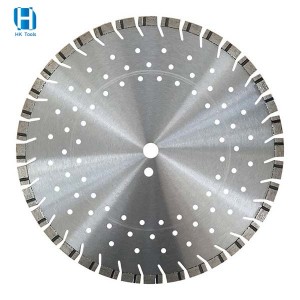
The best manufacturing process depends on the cutting material, working conditions, and expected frequency of use.
For occasional cutting jobs, a cold-pressed or brazed diamond blade may provide sufficient performance at a reasonable cost.
For professional users who cut hard materials frequently, hot-pressed or laser-welded diamond blades usually offer better durability and lower overall cost per cut.
Instead of focusing only on the initial purchase price, users should consider the blade’s cutting efficiency, service life, and total operating cost.
Final Thoughts
Each diamond saw blade manufacturing process has its own advantages and limitations. Understanding the differences between cold pressing, hot pressing, brazing, and laser welding helps users select the right blade for their specific applications.
Choosing the correct blade not only improves cutting performance but also reduces replacement frequency and improves overall work efficiency.
Post time: Jul-10-2026


